

In agriculture, auditing is key to evaluating an organisation’s compliance with environmental, social, and governance standards and identifying areas for improvement. Thanks to SIZA’s risk rating system (Bronze, Silver, Gold, and Platinum), a structured framework for continuous improvement has been established. An audit supports risk identification, data collection, and transparency for stakeholders.
Audits serve as effective risk-measurement tools for markets, providing a clear view of compliance levels across the agricultural sector. Risk ratings, such as Silver, Gold, or Platinum, are assigned, and each non-conformity is categorised by its severity (e.g., minor or major non-compliances). From a market perspective, these audits offer insight into how well ethics and compliance are managed within an organisation and highlight areas requiring improvement. From the supplier’s perspective, an audit, when properly executed, can be a vital risk management tool, identifying operational, environmental, and social vulnerabilities before they develop into major issues.
Over the past decade, the SIZA Audit Programme has evolved into a comprehensive and dynamic system focused on driving continuous improvement within the agricultural sector. What was once a snapshot-style audit has transformed into a robust support framework, enriched by training initiatives, practical documents, templates, videos, and multilingual resources. This evolution reflects SIZA’s commitment to making compliance both accessible and effective for all stakeholders. By forming global partnerships and building a programme rooted in trust and credibility, SIZA has shown that compliance cannot succeed in isolation—it requires a collective effort and a strong network of support. Essentially, it takes a country to ensure sustainable, responsible agricultural practices throughout agriculture.
What is the difference between a Combined and a Bolt-on Audit?
SIZA has adopted bespoke audit approaches for the benefit of producers in the form of combined audits and audits with a bolt-on.
The combined audit approach allows for a single third-party auditor to conduct a SIZA Environmental audit concurrently with another standard (such as the GLOBALG.A.P IFA). Here, a single auditor conducts two separate audits based on the different standards during the same visit, thus generating two separate audit reports and corrective action reports (CAPs). This in turn helps reduce audit costs, time, and effort by avoiding duplication.
Similarly, due to the high equivalence between the SIZA Environmental and LEAF Marque standards, a bolt-on approach between the two standards exists to allow for third party audit to be conducted based on the SIZA Environmental Standard, with an additional bolt-on during the same audit visit to cover the remaining requirements of the LEAF Marque standard. This also reduces audit costs, time, and efforts. This type of audit produces a single audit and CAP report.
The benefits
For the greatest benefit, suppliers may choose to undergo a combined SIZA and GLOBALG.A.P audit with the LEAF bolt-on, thereby inducing extensive cost savings.
For suppliers, especially those with limited time and resources, a combined audit offers several key advantages:
- Lower Costs – Fewer audits result in lower fees and reduced resources spent on preparation.
- Time-Saving – Workers spend less time preparing for multiple audits. Fewer on-site interviews are needed, as only one worker sample is used throughout the process. Management spend less time duplication documents.
- More Efficient Data Collection – All information is gathered in a single process, often by one auditor, making data easier to manage and retrieve.
- Clearer Expectations – A combined audit helps reduce confusion caused by differing scheme requirements and standards.
Therefore, combined audit provide value by saving on audit costs, time, and efforts, and improving coordination between the auditor and farmer regarding expectations of the audit. As a result, SIZA’s combined audit option lowers the barrier-to-entry for agri-suppliers wanting to access multiple markets, thereby enhancing commercialisation efforts.
The challenges
For the auditors and audit firms, conducting a combined-audit or an audit with a bolt-on is no mean feat. For the auditors, there is an inflated competency requirement due to having to understand and discern between multiple audit methodologies. Other challenges for auditors include appropriately allocating and addressing risk where it is identified, operating under constrained time requirements, and effectively communicating the complexities of the combined audit or audit bolt-on approach for the client’s understanding.
For audit firms, challenges related to combined audits and audit with a bolt-on include a reduced auditor pool due to auditors having to be skilled in multiple standards, and ensuring reporting consistency within each relevant standard.
Cost savings
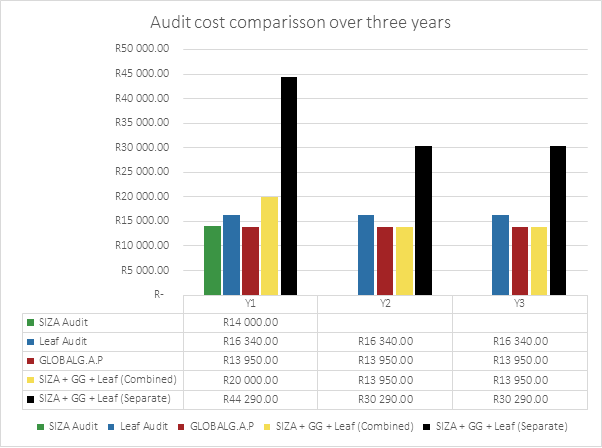
The graph above illustrates the theoretical cost savings induced by the combined audit approach with the LEAF Bolt-on. As the SIZA Audit Frequency Matrix allows for an audit validation period of up to 3 years, cost-savings have been calculated on a three-year cycle. The cost of maintaining environmental compliance with SIZA, GLOBALG.A.P, and LEAF Marque separately is approximately R105 000.00 over three years (or approximately R35 000 on average per annum). When harmonised into a single combined audit with a bolt-on, the cost of maintain environmental compliance with SIZA, GLOBALG.A.P, and LEAF Marque reduces significantly to approximately R48 000 over three years (or approximately R16 000 on average per annum). Overall, cost savings may reach up to 54% (approximately R 57 000) over three years.
Overall, auditing is a vital tool in the agricultural sector, offering suppliers and markets a reliable means of measuring compliance, identifying risk, and encouraging continuous improvement. SIZA’s risk rating framework and its combined audit approach make the auditing process more efficient and cost-effective, particularly for suppliers operating with limited resources – facilitating increased market access.
- Learning and discerning between two standard methodologies (competency req)
- Allocating sections of the audit so that all risks are identified and approriatley addressed
- Divergent criteria and expanded scope (especially of bolt-ons with their own principles)
- Greater time requirement
- Client understanding
Challenges: (audit firm)
- Competency requirements (audits needing to be skilled on multiple standards) reduces auditor pool
- Consistency: ensuring uniformity and consistency in reporting with the relevant standard.


